
When Does the Workday Actually Begin?
At 7:00 AM, Rohan leaves his home in Borivali for his office in BKC. His official workday begins at 9:00 AM. But in reality, his day at work has already begun.
The train is crowded. Breakfast is rushed. For the next 90 minutes, he navigates crowds, noise and uncertainty. By the time he reaches his desk, he has already spent physical and mental energy simply getting to work.
Rohan is not an exception. Across Mumbai, Bengaluru, Delhi NCR and other Indian cities, commuting has become an unavoidable part of working life. A study examining commute time in Bengaluru found an average one-way commute of 42.45 minutes (Sridhar & Nayka, 2022). Research involving Mumbai local-train commuters also found significant commuting stress, with women experiencing a greater negative impact (Mohan & Kulkarni, 2022).
"In India's congested cities, the commute isn't just 'dead time' - it's prime time that shapes our day before the first email is sent."
Yet organisations rarely account for this time. We measure working hours, productivity, engagement and well-being. But the journey to work remains largely outside the employee-experience conversation.
The Commute Tax
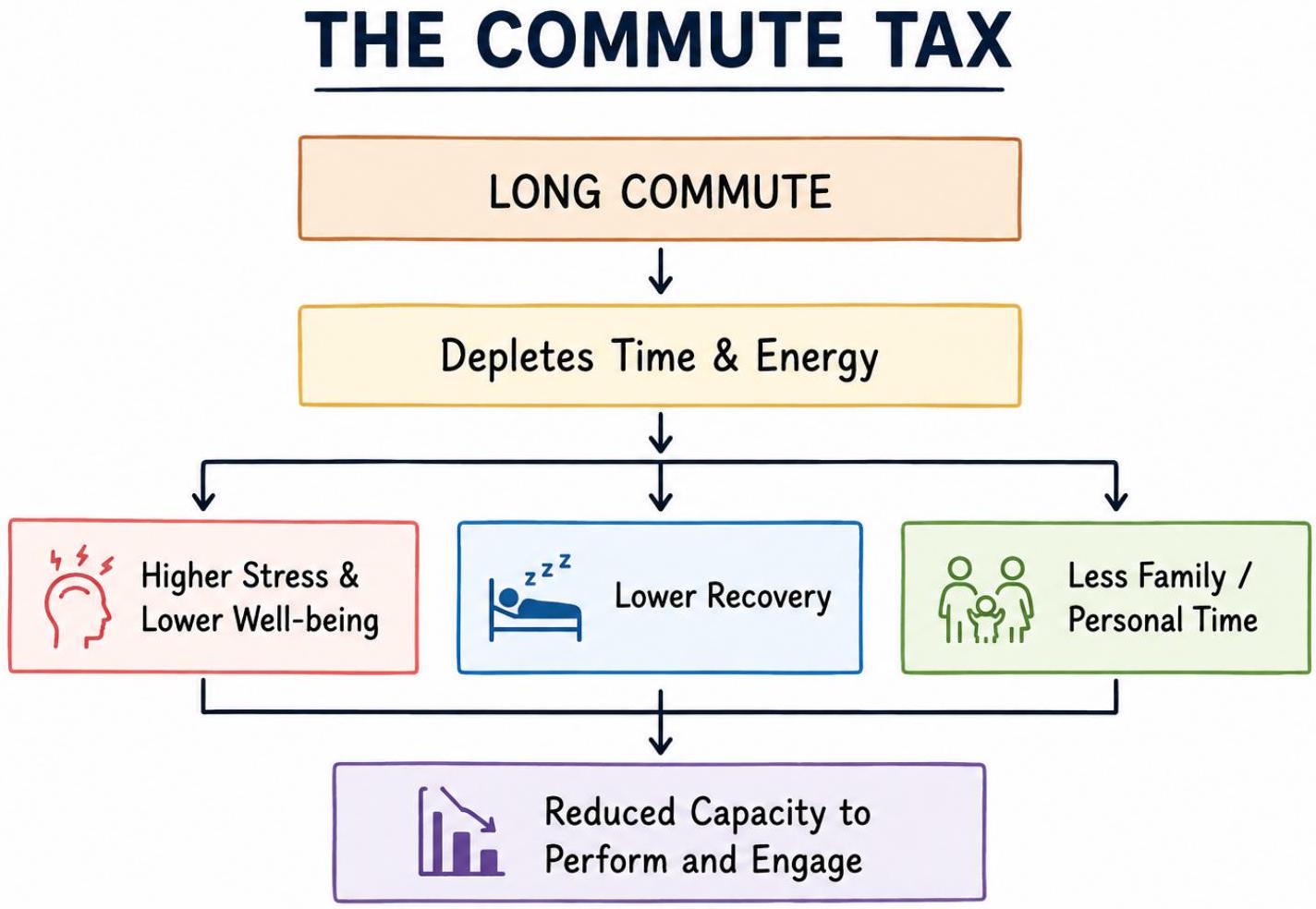
The Commute Tax is the hidden cost employees pay to get to work-not in money, but in time, energy, attention, recovery and emotional bandwidth.
Long and stressful journeys can affect mood, recovery and the time available for personal life (Nature Research Intelligence, 2025). International research has also linked longer commute times with poorer mental-health outcomes; for example, Wang (2023) reported that each additional 10 minutes of commuting was associated with a 1.1% increase in the likelihood of depressive symptoms.
The productivity question matters too. Research on high-tech inventors found that additional commuting distance was associated with fewer patents and lower patent quality, particularly among high-performing inventors (Lambert, 2021).
"The Great Indian Commute is one of the longest and least-studied parts of our workday.."
The point is that commuting remains an overlooked source of daily strain. Thus, no wonder burnout rates are climbing. The commute may not cause burnout on its own; it may contribute to the cumulative demands employees carry into and out of work.
A Research Gap in India
While rich international evidence ties long commutes to stress, poorer recovery and underperformance, very few studies focus specifically on India.
The "Great Indian Commute" remains under-studied in I/O Psychology. Sridhar and Nayka (2022) highlight the limited research on commute time in the Indian intra-urban context.
This gap matters because organisational research often focuses on what happens inside organisations-leadership, engagement, performance, skills and retention-while external conditions such as housing, distance and transportation receive less attention.
Yet these conditions shape employees before they enter the workplace. The question, therefore, is not simply how long an employee works? It is also: What has the employee already experienced before work begins?
A Psychological Lens: Effort, Recovery and Resources
From a Psychological perspective, commuting can be understood as an additional demand associated with the workday.
The Effort-Recovery model suggests that sustained effort requires adequate recovery. A stressful commute can extend the period of effort before work and interfere with recovery after work (van Hooff, 2015).
The Job Demands-Resources model offers another lens. When demands are high and resources are insufficient, employees are more vulnerable to exhaustion and strain (Bakker & Demerouti, 2007). An unpredictable, crowded or lengthy commute can function as an additional demand without providing an equivalent resource.
Finally, Conservation of Resources theory suggests that people strive to retain and protect valued resources such as time and energy (Hobfoll, 1989). Every additional hour spent commuting is an hour unavailable for sleep, exercise, family, learning or recovery.
The commute, therefore, is not simply about transportation. It is about human capacity.
Why Should Organisations Care?
Organisations cannot redesign Mumbai's railway network or Bengaluru's roads. But they can redesign aspects of the employee experience around the commute.
1. Measure commute burden
Employee listening should go beyond engagement scores. Organisations can understand commute duration, predictability and stress as part of the broader employee experience.
2. Build flexibility around peak hours
Where roles permit, staggered start times, hybrid work and location flexibility can reduce exposure to the most congested periods.
3. Rethink work design
Office location, meeting schedules and transport support are not merely operational decisions. They can influence employee energy, recovery and experience.
4. Manage for outcomes
Where work allows, evaluate employees on results rather than assuming that physical presence or early arrival automatically reflects performance.
These interventions do not require organisations to solve India's infrastructure challenges. They require organisations to recognise that the commute is part of the context in which work happens.
Conclusion
India's future of work cannot be designed only around what happens after employees arrive at the office. Employees bring their accumulated experiences into the workplace-and the journey there is part of that experience.
Long commutes can consume time, energy and recovery capacity. Stressful journeys can spill over into work and personal life. The answer is not to treat transportation as an HR problem, but to recognise that the employee experience does not begin at the office door.
Understanding commuting through an Work Psychology lens allows organisations to widen the way they think about performance and well-being. Technology, flexible work and wellness programmes can help, but they cannot fully address workplace challenges if the human context surrounding work is ignored.
By recognising the psychological tax of commuting, organisations can design more humane and sustainable work systems-ones that reflect how Indian employees actually live and work. "If firms want their best people to perform at their peak, they must do more than invest in technology-they must also invest in the human journey to work."
The future of work in India should not only ask where people work. It should also ask what psychological costs they pay to get there….
References
8 citations- Sridhar, K. S., & Nayka, S. (2022). Determinants of Commute Time in an Indian City. Margin: The Journal of Applied Economic Research, 16(1), 49-75. DOI: 10.1177/09749101211073375.
- Mohan, R., & Kulkarni, M. (2022). Stress and Adaptation Among Mumbai Local Train Commuters. Psychological Studies, 67, 43-52. DOI: 10.1007/s12646-022-00639-w.
- Lambert, L. (2021, March 30). Commuting Hurts Productivity and Your Best Talent Suffers Most. Harvard Business School Working Knowledge.
- Wang, X. (2023). Longer Commutes and Mental Health Risks. NUS Cities.
- van Hooff, M. L. M. (2015). The Daily Commute from Work to Home: Examining Employees’ Experiences in Relation to Their Recovery Status. Stress and Health, 31, 124-137. DOI: 10.1002/smi.2534.
- Bakker, A. B., & Demerouti, E. (2007). The Job Demands-Resources Model: State of the Art. Journal of Managerial Psychology, 22, 309-328.
- Hobfoll, S. E. (1989). Conservation of Resources: A New Attempt at Conceptualizing Stress. American Psychologist, 44(3), 513-524.
- Nature Research Intelligence. (2025). Commuting Effects on Mental Health and Wellbeing.

Vipul Paliwal
Co-Founder, AllthingsIO | Business Psychologist
Vipul is a Business Psychologist and Co-Founder of AllthingsIO, with expertise in I/O Psychology, workplace well-being, and strategic human capital consulting.
Continue Reading
India's Internship Economy: Why Internships Have Become the Unofficial Fourth Year of College
More Than a Degree: Why Experience Has Become the New Qualification

Anushree Kabra
Oct 22, 2025
AI Adoption in India: Turtle Momentum
Why Indian companies are experimenting but struggling to transform

Agrima Juneja
Oct 24, 2025